Open-sourcing synthdocs: OCR training data for ugly documents
55,595 synthetic pages from 9 regulated industries, in English and Canadian French, faxed, scanned, crumpled and coffee-stained on purpose. Free under CC BY 4.0.
The documents our customers send us are not clean PDFs. They are certificates of insurance that went through a fax machine twice, invoices photographed on a desk, leases that spent a week folded in a pocket, and lab reports with a coffee ring on them. Half of them are in French.
Public OCR datasets rarely look like that. They are mostly academic papers, receipts and clean scans in English. A model trained on them reads a research paper well and a third-generation photocopy of a bill of lading badly.
So we built our own training data. Today we're releasing part of it: synthdocs, free under CC BY 4.0.
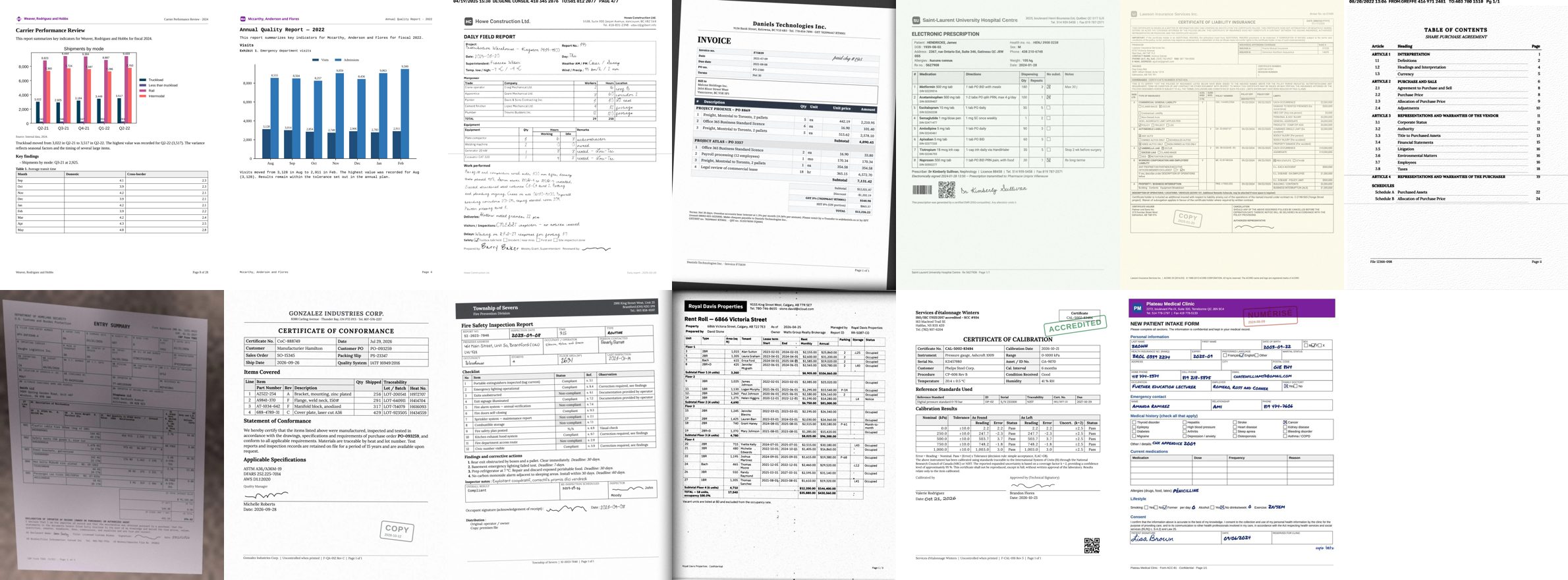
What's in it
- 55,595 pages from 9 regulated industries: insurance, healthcare, legal, financial services, real estate, public sector, manufacturing, construction and logistics.
- 80 document types, from claim intake forms and discharge summaries to lien waivers, rent rolls and customs declarations.
- About 30% in Canadian French. 37,907 English pages and 17,688 French pages, and some English pages have bilingual labels.
- 17 kinds of real-world damage. Flatbed scans, skewed scans, 1-bit and dithered faxes, phone photos, blurry photos, third-generation photocopies, crumpled paper, ink bleeding through from the back, coffee stains, dot-matrix printing, faded thermal paper, and screen photos with moiré. About 4,000 pages are left clean.
The pages are split into three subsets. core has 49,995 pages across all 80 document types and all 17 kinds of damage. charts adds 2,300 report pages with bar, line and pie charts. styles adds 3,300 pages with varied fonts, colors and layouts.
Exact ground truth
Every page is generated, so every label is exact. Each page comes with a JSON file that has:
- the full page as markdown, in reading order
- layout boxes for 16 region categories, such as headers, paragraphs, tables, form fields and signatures
- the markdown for each region
- every table in OTSL, HTML and markdown, merged cells included
That makes the dataset useful for page-to-markdown models, layout detection, table structure recognition, and French OCR on Canadian business documents. A manifest lists every page with its industry, document type, language and kind of damage, so you can pick, for example, only French fax pages before you download anything.
How it trains rakedoc-nano
synthdocs is a subset of the data we use to train our document parsing models, including rakedoc-nano. That model returns a bounding box for every element it emits, text included. It can only do that because the training data has a box for every region.
The damage matters as much as the boxes. A parser that has only seen clean pages fails on a fax, and in regulated industries a lot of documents still arrive by fax.
Limits
All pages are synthetic. Text, numbers and layouts look realistic, but they are generated. Names, addresses, phone numbers and account numbers are fake and follow Canadian formats. Every page is a single US Letter page, and there are no multi-page documents. Charts have a box but no transcription. Use real documents to evaluate a model before you put it in production.
Get it
The repository has the docs, the manifest, the schema and sample pages. The images are in tar shards on the v1.0 release, one per industry, about 12 GB in total. You can download one industry or all of them:
scripts/download.sh data core-legal core-healthcare charts
You can use, share and change the data, commercially too, as long as you credit CloudRaker. If you'd rather not train a parser yourself, rakedoc-nano is already trained on it. Its weights are on Hugging Face, and it runs behind Parse in the CloudRaker API.
FAQ
Yes. It's licensed under CC BY 4.0, so you can use, share and change it for any purpose, including commercial use, as long as you credit CloudRaker.
No. synthdocs is a subset of the training data we use for our document parsing models.
No. Every page is synthetic. Names, addresses, phone numbers, emails, account numbers and company names are all fictional.
About 12 GB, split into one shard per industry plus one for charts and one for styles. You can download only the shards you need.