Assign

Always the Right AI for the Job
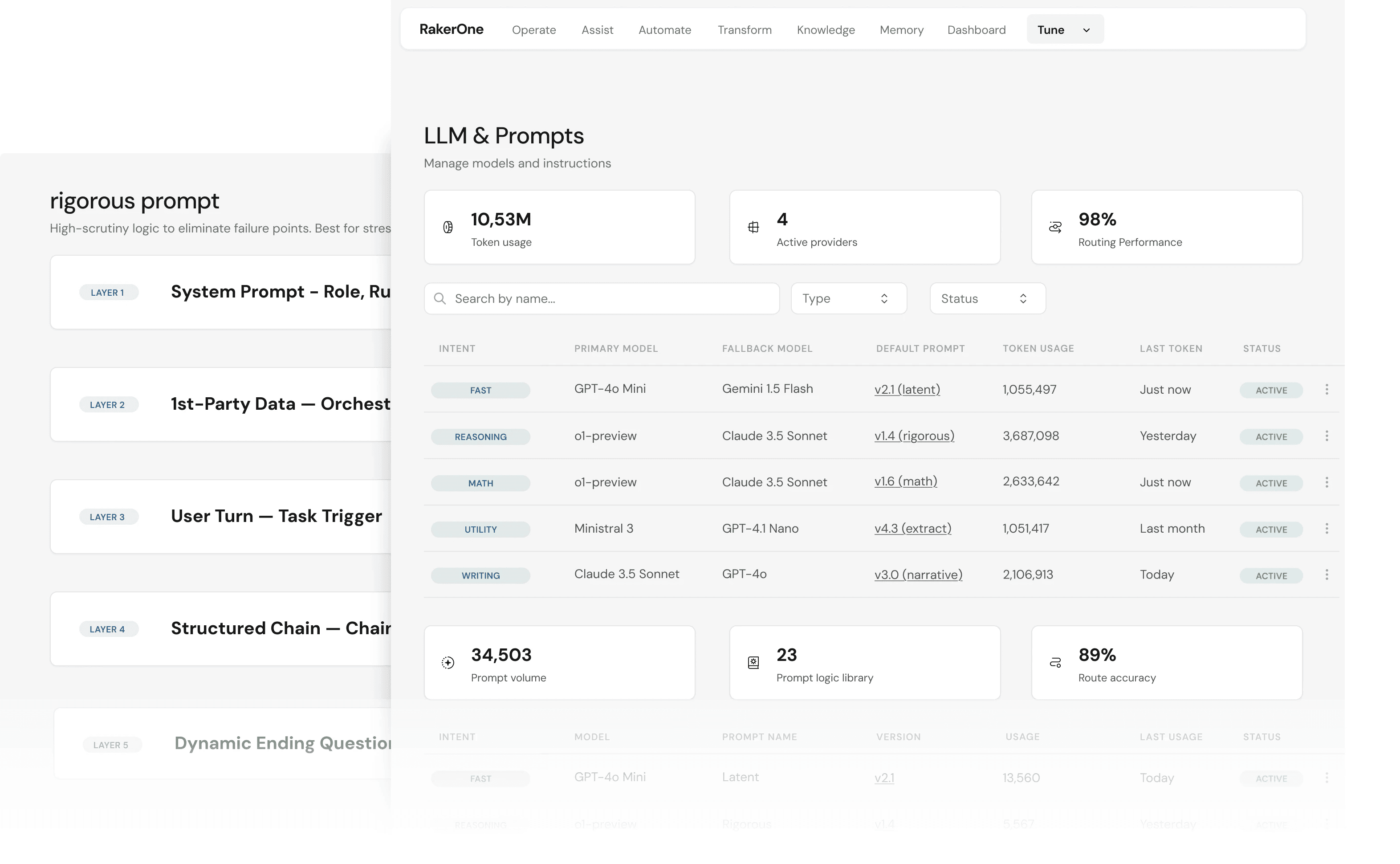
Assign interface
Assign interface
Assign interface

Automatically route every task to the best AI model based on intent, performance, cost, and availability.

Automatically route every task to the best AI model based on intent, performance, cost, and availability.

Automatically route every task to the best AI model based on intent, performance, cost, and availability.

LLM-Agnostic

Assign works across models and providers, OpenAI, Anthropic, open-source, or private models, without locking your business into any single vendor.

Intent-Based Selection

Each task is analyzed to determine what matters most: reasoning, math, writing, extraction, speed, or cost, then routed accordingly.

Resilience Built In

If a model is degraded, unavailable, or throttled, Assign automatically switches to the next best option without breaking workflows.

How Assign works

How Assign works

A task is triggered by a user, agent, or workflow

A task is triggered by a user, agent, or workflow

A task is triggered by a user, agent, or workflow

Intent and task characteristics are detected

Intent and task characteristics are detected

Intent and task characteristics are detected

The optimal model is selected dynamically

The optimal model is selected dynamically

The optimal model is selected dynamically

Execution runs with fallback and safeguards

Execution runs with fallback and safeguards

Execution runs with fallback and safeguards

Results are returned, tracked, and optimized

Results are returned, tracked, and optimized

Results are returned, tracked, and optimized

Core capabilities of Assign

Core capabilities of Assign

Core capabilities of Assign

Model Routing Engine

Intent & Performance

Cost-Aware

Automatic Fallback

Multi-Provider Support

Governed Model Usage

Automatically selects the best AI for every task.

Routes by task type

Works across providers

Invisible to users

Model Routing Engine

Intent & Performance

Cost-Aware

Automatic Fallback

Multi-Provider Support

Governed Model Usage

Automatically selects the best AI for every task.

Routes by task type

Works across providers

Invisible to users

Model Routing Engine

Intent & Performance

Cost-Aware

Automatic Fallback

Multi-Provider Support

Governed Model Usage

Automatically selects the best AI for every task.

Routes by task type

Works across providers

Invisible to users

Powered by the best-in-class large language models

Powered by the best-in-class large language models

  • Asana logo
  • Linear.app logo
  • Mailchimp logo
  • Confluence logo
  • Zapier logo
  • Slack logo
  • Loom logo
  • Google Meet logo
  • Spectrum logo
  • Linear.app logo
  • Mailchimp logo
  • Confluence logo
  • Zapier logo
  • Slack logo
  • Loom logo
  • Google Meet logo
  • Spectrum logo
  • Spectrum logo
  • Spectrum logo
  • Spectrum logo
  • Spectrum logo
  • Spectrum logo
  • Spectrum logo
  • Spectrum logo
  • Spectrum logo
  • Spectrum logo
  • Asana logo
  • Linear.app logo
  • Mailchimp logo
  • Confluence logo
  • Zapier logo
  • Slack logo
  • Loom logo

General models

General models

Best for complex workflows and high-stakes operational decisions

OpenAI GPT

OpenAI o-series

Google Gemini

Anthropic Claude

xAI Grok

Industry models

Industry models

Best for regulated environments requiring domain accuracy

Google MedLM

BloombergGPT

BioGPT

Alibaba Qwen

Fine-tuned Models

Efficient models

Efficient models

Best for high-volume automation and cost-controlled scaling

Google Gemma

Mistral

Microsoft Phi

Meta Llama

DeepSeek

The Assign model

The Assign model

The Assign model

Assign is not

A hard-coded model choice

A single-provider AI strategy

A manual toggle between LLMs

A fragile dependency on uptime

white clouds and blue sky during daytime

Assign is

An AI routing and optimization layer

Future-proof against model churn

Designed for production workloads

Built for performance, cost, and trust

Further questions?

How does Assign decide which model handles a task?

How quickly will this reduce manual work for our teams?

Can we choose between proprietary and open models?

How quickly will this reduce manual work for our teams?

Can we control where models run?

How quickly will this reduce manual work for our teams?

How are token and usage costs managed?

How quickly will this reduce manual work for our teams?

Can we change models or infrastructure later?

How quickly will this reduce manual work for our teams?

From intent to outcome

Examples of tasks routed to the right AI automatically.

From intent to outcome

Examples of tasks routed to the right AI automatically.

From intent to outcome

Examples of tasks routed to the right AI automatically.

“Calculate variance across datasets”

Best math model selected

Computation applied

Results validated

Usage logged

“Calculate variance across datasets”

Best math model selected

Computation applied

Results validated

Usage logged

“Summarize risks and recommend actions”

Reasoning model selected

Context window optimized

Trade-offs evaluated

Decision trace recorded

“Summarize risks and recommend actions”

Reasoning model selected

Context window optimized

Trade-offs evaluated

Decision trace recorded

“Summarize risks and recommend actions”

Reasoning model selected

Context window optimized

Trade-offs evaluated

Decision trace recorded

“Draft a client-ready update”

Extraction model selected

Structure enforced

Confidence thresholds applied

Output governed

“Draft a client-ready update”

Extraction model selected

Structure enforced

Confidence thresholds applied

Output governed

“Draft a client-ready update”

Extraction model selected

Structure enforced

Confidence thresholds applied

Output governed

Ready for Operational Autonomy?

Let’s discuss your operational bottlenecks and how AI can solve them in 30 days.

Ready for Operational Autonomy?

Let’s discuss your operational bottlenecks and how AI can solve them in 30 days.

Ready for Operational Autonomy?

Let’s discuss your operational bottlenecks and how AI can solve them in 30 days.

Powered by the best-in-class large language models

  • Asana logo
  • Linear.app logo
  • Mailchimp logo
  • Confluence logo
  • Zapier logo
  • Slack logo
  • Loom logo
  • Google Meet logo
  • Spectrum logo
  • Linear.app logo
  • Mailchimp logo
  • Confluence logo
  • Zapier logo
  • Slack logo
  • Loom logo
  • Google Meet logo
  • Spectrum logo
  • Spectrum logo
  • Spectrum logo
  • Spectrum logo
  • Spectrum logo
  • Spectrum logo
  • Spectrum logo
  • Spectrum logo
  • Spectrum logo
  • Spectrum logo
  • Asana logo
  • Linear.app logo
  • Mailchimp logo
  • Confluence logo
  • Zapier logo
  • Slack logo
  • Loom logo

General models

Best for complex workflows and high-stakes operational decisions

OpenAI GPT

OpenAI o-series

Google Gemini

Anthropic Claude

xAI Grok

Industry models

Best for regulated environments requiring domain accuracy

Google MedLM

BloombergGPT

BloBioGPT

Alibaba Qwen

Fine-tuned Models

Efficient models

Best for high-volume automation and cost-controlled scaling

Google Gemma

Mistral

Microsoft Phi

Meta Llama

DeepSeek